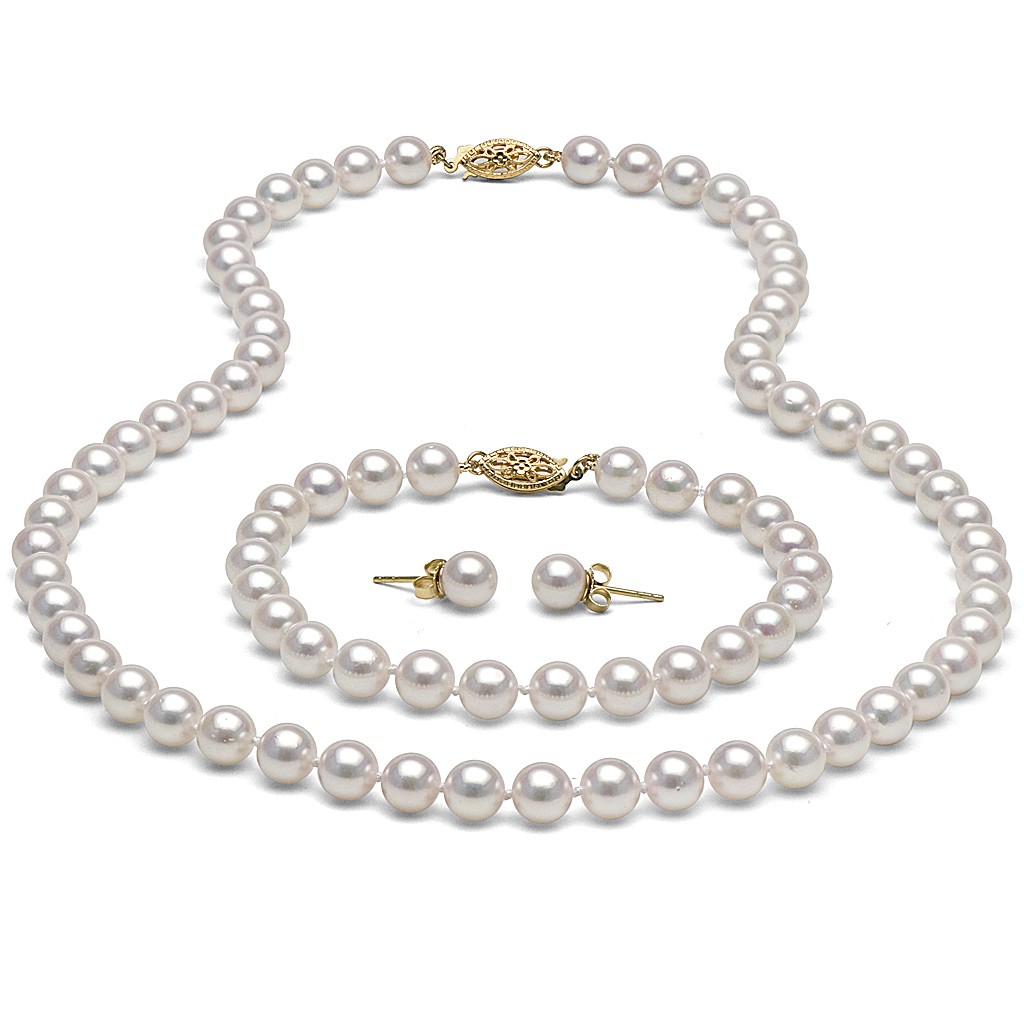
All Pearl Types
and pearl Culturing methods
Pearls are natural gems formed through a precise biological process. It all begins when a foreign object, such as a grain of sand, enters an oyster. The oyster responds by coating it with layers of calcium carbonate (CaCO3) and conchiolin, creating nacre. This process takes about 10 years.
The quality of pearls depends on the type of oyster, its habitat, and the cultivation techniques used. These techniques, developed in the late 19th century by biologist William Saville Kent, allow for the production of high-quality pearls in both freshwater and saltwater.
Understanding this process helps us appreciate the uniqueness and value of each pearl, from its biological formation to its final beauty.
Pearls are natural gems of incomparable beauty and uniqueness, formed through a highly specialized biological process. This process begins when a foreign object, such as a grain of sand or a parasite, enters the oyster. In response, the mollusk activates its natural defense mechanism, secreting successive layers of nacre, a mixture of calcium carbonate (CaCO3) and conchiolin, an essential structural protein. Over time, these layers coat the irritant, transforming it into a pearl.
The formation of a pearl is a long and meticulous process that can take approximately 10 years, during which nacre gradually accumulates to create a complete and perfectly structured pearl. This phenomenon occurs in both freshwater and saltwater oysters, each producing pearls with unique characteristics and qualities.
The quality, luster, and iridescence of pearls depend on various factors, including the species of oyster, the habitat conditions, and the cultivation techniques used. For instance, saltwater pearls often have a more intense luster due to the marine conditions and the specific type of nacre produced by these oysters.
Oyster farming and pearl production have significantly advanced thanks to scientific and technological developments. Modern cultivation techniques are based on principles established in the late 19th century by Australian biologist William Saville Kent. His pioneering research laid the groundwork for controlled and precise methods of inserting nuclei into oysters, enabling the consistent and sustainable production of high-quality pearls.
These methods include the careful selection of mother oysters, proper preparation of the nuclei, and maintaining optimal conditions in pearl farms. Cultivators constantly monitor factors such as water temperature, salinity, and oyster nutrition to ensure an ideal environment for pearl formation.
Understanding these processes and techniques allows us to appreciate even more the uniqueness and value of each pearl. From its biological origin to the meticulous care in its cultivation and its stunning final presentation, every pearl tells a story that reflects the wonder and complexity of nature.
Types of Culturing
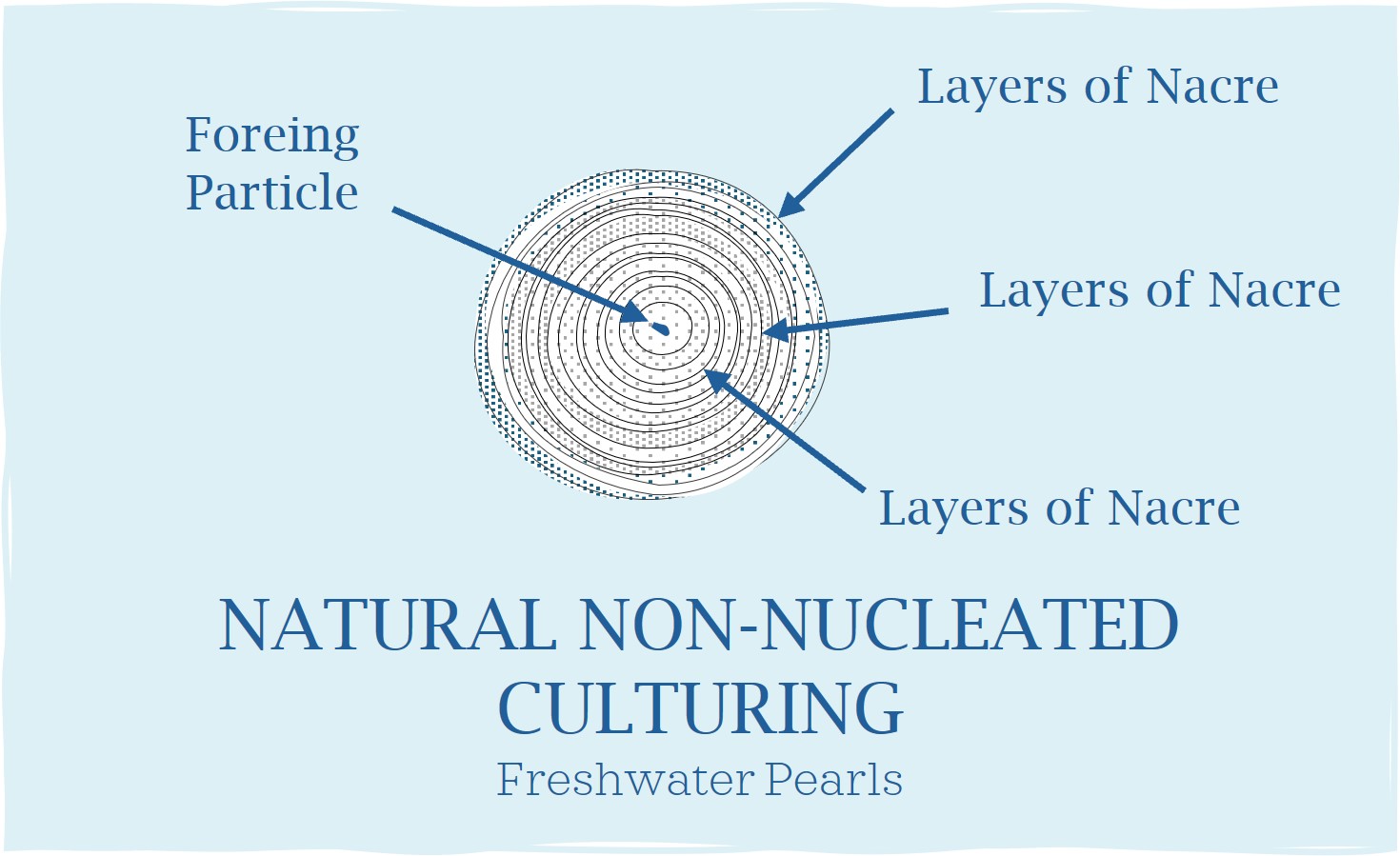
Natural Non-Nucleated Culturing
Freshwater Pearls
The Non-Nucleated Culturing Method is a technique predominantly used in the production of freshwater pearls, in which no solid nucleus is employed. Instead, a small piece of mantle tissue is implanted into the mussel or oyster. This tissue contains epithelial cells that begin secreting nacre, which leads to the formation of the pearl.
This method is highly efficient, as a single mussel can produce multiple pearls simultaneously. The pearls resulting from this process often have more irregular shapes compared to nucleated pearls, but they exhibit a more homogeneous nacre thickness due to the absence of a central nucleus. This gives them exceptional durability and luster.
The culturing period for non-nucleated pearls ranges from three to eight years, depending on environmental conditions and the species of oyster used. This biological cultivation process is primarily natural, with human intervention mainly involved in initiating pearl formation by implanting the tissue. As the oyster secretes layers of nacre around the implanted tissue, pearls form with a high nacre content, large sizes, and a remarkable variety of shapes.
As a result, freshwater pearls produced using this technique are not only durable and lustrous but also offer a unique variety in terms of shape and size, making them a versatile and attractive choice in the jewelry market.
Synthetic Nucleus Culturing
Akoya, Mabe, South Sea, Tahitian Pearls
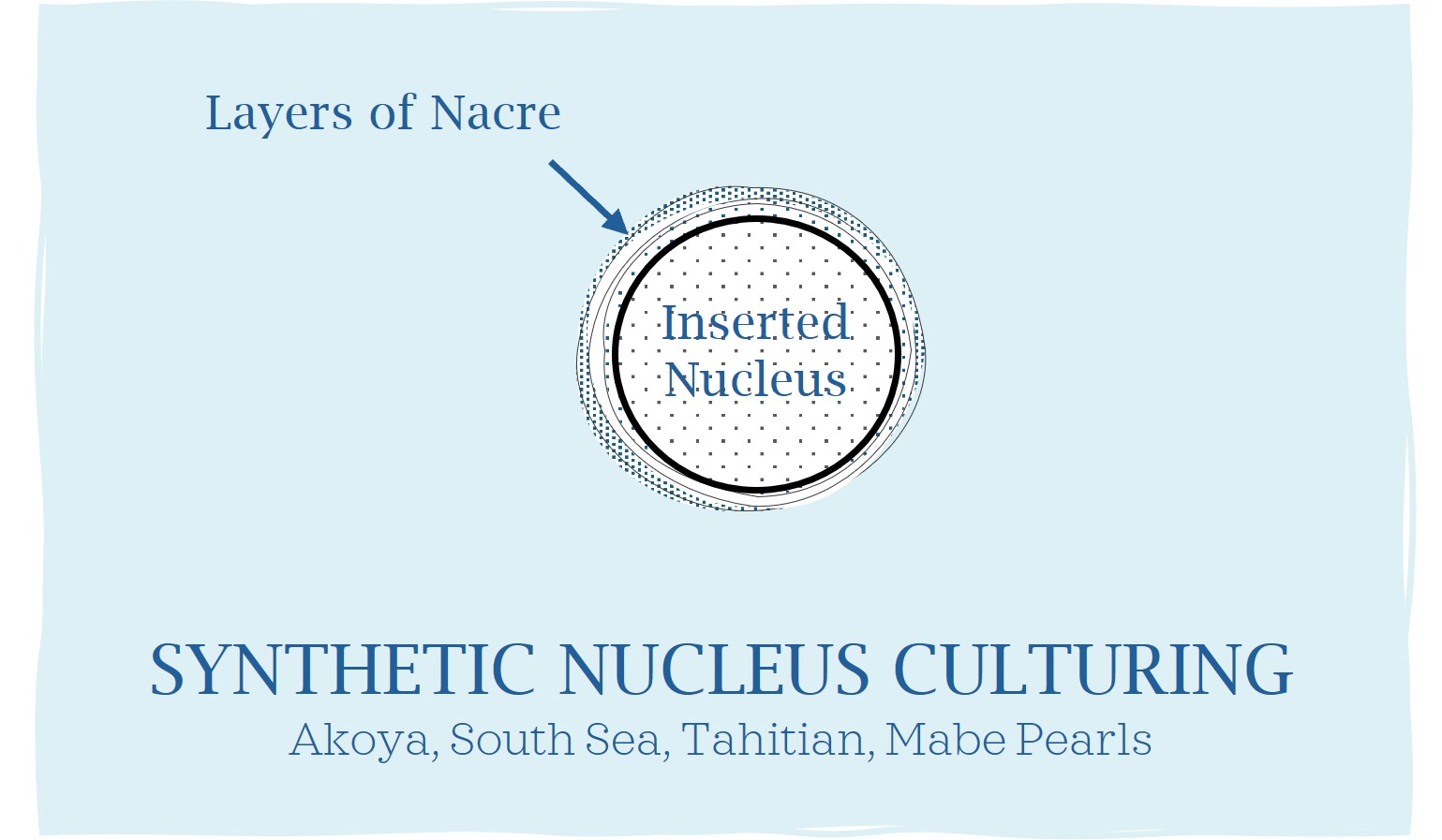
The Nucleated Culturing Method is an advanced technique used to produce high-quality pearls, such as the renowned Akoya, South Sea, and Tahitian pearls. This method involves the implantation of a solid nucleus, typically a mother-of-pearl sphere ranging from 5 to 10 mm in diameter, into the oyster's mantle. In addition to the nucleus, a small piece of mantle tissue from a donor oyster is also implanted, containing epithelial cells specialized in secreting nacre.
Once the nucleus and tissue are inserted, the oyster begins to coat the nucleus with successive layers of nacre. This process can take anywhere from 6 months to several years, depending on the type of pearl being cultured. The primary goal of this technique is to produce pearls with a round and uniform shape, highly valued in the jewelry market.
The cultivation period typically ranges from one to three years. However, extending the cultivation period beyond this time can be ineffective, as approximately 80% of nucleated oysters do not survive long enough to produce a high-quality pearl. This technique has been developed and refined primarily in Japan, where it has become the foundation for producing the famous Akoya pearls.
Pearls obtained through this method are distinguished by their perfectly round shape, brilliant luster, and a size generally less than 10 mm. However, due to the relatively thin nacre layer compared to other types of pearls, these pearls require delicate care to maintain their luster and quality over time.
Pearl Farms
In rivers, lakes, and oceans
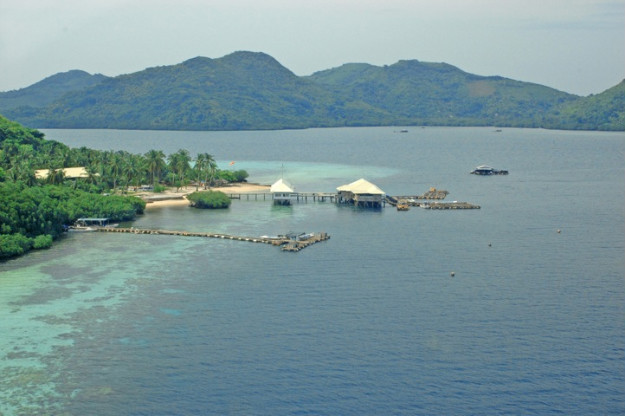
Today, pearl production takes place exclusively in controlled farms that utilize advanced cultivation techniques, completely replacing the harvesting of natural pearls. These farms can be found in oceans, rivers, and lakes, and the quality of the pearls produced depends on various factors, including water purity, wave stability, temperature, and the concentration of dissolved salts, among others.
Currently, river-based farms, located in lakes connected to main waterways, have matched and even surpassed the quality of open sea farms. This is largely due to their ability to more precisely control the multiple variables that influence this delicate culturing process.
Types of Pearls
South Sea Pearls (Australian)
The Grandeur of the Ocean in Every Pearl
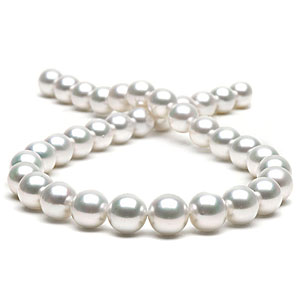
South Sea pearls, renowned worldwide for their impressive size and exceptional luster, are cultivated in the warm, pristine waters of Australia, the Philippines, and Indonesia. These pearls are produced by the Pinctada Maxima oyster, the largest species used in pearl production, allowing these gems to reach astonishing sizes of up to 20 mm in diameter.
The culturing of South Sea pearls is a delicate and labor-intensive process that can take between two and four years. During this time, the oysters are carefully nurtured in controlled environments, where water conditions, temperature, and food quality are meticulously monitored. The Pinctada Maxima oyster is known for producing an exceptionally thick nacre, resulting in pearls with a deep luster and an iridescence that uniquely captures light.
South Sea pearls are distinguished by their smooth texture, natural beauty, and diversity of shapes and colors. They can range from silvery white to deep gold, with shades of cream in between, and their shapes can be round, oval, or even baroque. These pearls are true natural treasures, each with its own personality and charm, making them an ideal choice for those seeking something truly special and unique.
Freshwater Pearls
Quality and Affordability
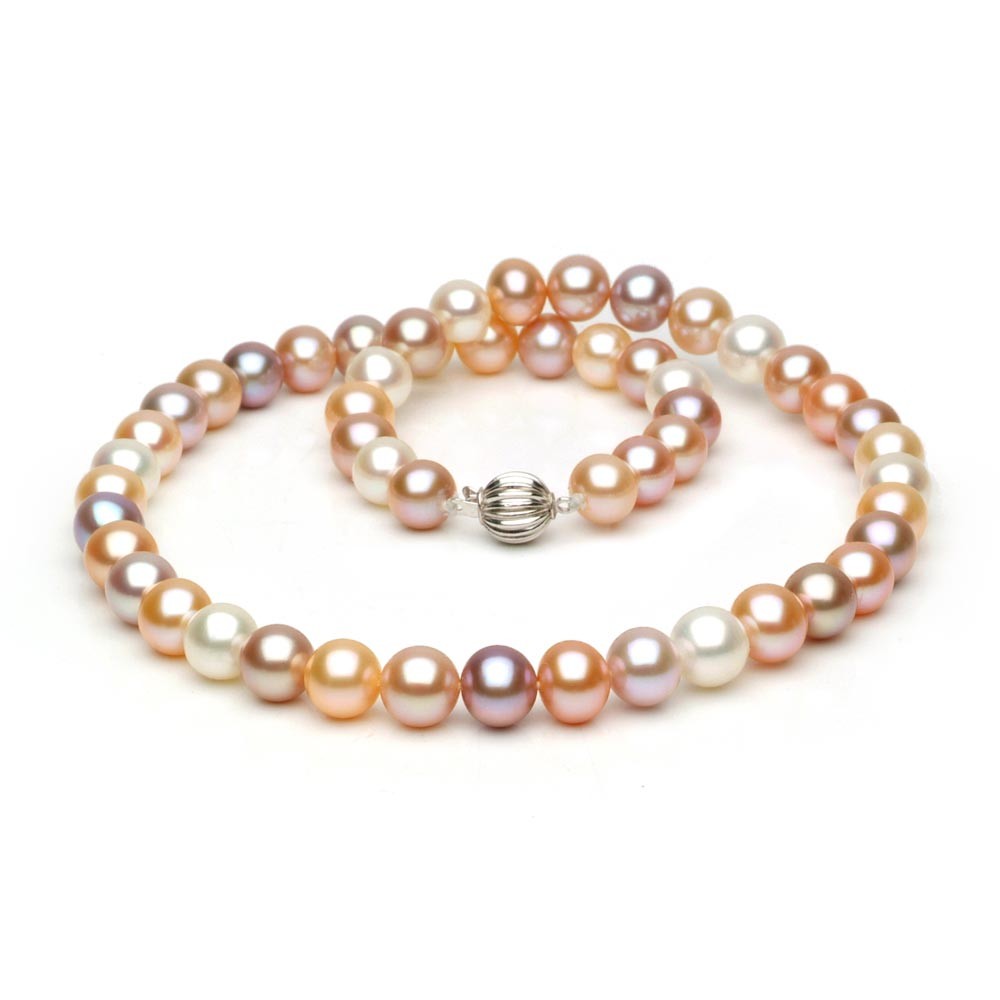
Freshwater pearls, are primarily cultured in China, Japan, and the United States, using mollusks such as the Ikekou (Unio Margaritifera) and Cumingi of Hyriopsis. These freshwater mollusks have the remarkable ability to produce multiple pearls simultaneously, in a wide range of colors and shapes.
The culturing process for these pearls can take between 3 and 8 years. Before the 1990s, Freshwater Pearls were small and irregular in shape, often resembling grains of rice. However, since the 1990s, the quality of these pearls has improved dramatically due to advances in culturing techniques and the expansion of this practice in China. This improvement has made Freshwater Pearls a viable alternative to the traditional nucleated Akoya pearls, as well as other more selective types like Tahitian Black Pearls or Australian South Sea Pearls.
Freshwater Pearls are particularly valued for their high nacre content, which gives them a soft, enduring luster. Additionally, they offer a great diversity of shapes, colors, and sizes, with some pearls reaching up to 16 mm. This variety and quality make freshwater pearls an attractive and versatile choice for all types of jewelry.
Japanese Cultured Pearls (Akoya)
The Traditional Spherical Pearl
Japanese pearls, derived from the Akoya oyster (Pinctada Fucata), are primarily cultivated in the saltwater of Japan, although they are also grown in China and Vietnam. These pearls are considered the most complex to culturing due to the advanced techniques that involve synthetic nucleation. Only about 5% of large, spherical implantations result in a high-quality pearl with a diameter greater than 7 mm and an almost perfectly round shape.
Because of the significant size of the implanted nuclei, the culturing time is reduced to less than a year and a half, during which the oyster covers the foreign body with two or three layers of nacre.
These pearls are distinguished by their nearly perfect round shape and intense iridescence. The tones of Akoya pearls vary depending on the cultiring process, offering varieties in white, pink, and cream, which are highly valued for their elegance and characteristic luster.
Tahitian Pearls
The Black Pearls
Tahitian pearls, known for their exotic and unique beauty, are predominantly cultivated in the saltwater lagoons of French Polynesia, not in Tahiti as their name might suggest. Although commonly referred to as "black pearls," these pearls actually display a range of colors that extends far beyond traditional black. Their hues vary from gray with overtones of green, orange, magenta, or gold, to the most intense cobalt blues, offering a color palette unique in the world of jewelry.
Originating from the Pinctada Margaritifera oyster, these pearls are cultivated in warm waters over a period of 2 to 3 years. The cultivation process is complex and challenging, as the survival rate of the oysters is low, and most of the pearls produced have surface imperfections. This makes the flawless Tahitian pearls that do form extremely valuable and highly sought after in the fine jewelry market.
The size of these pearls ranges from 8 to 18 mm, with a luster and depth of color that make them stand out as true natural treasures, perfect for those seeking a unique and exotic piece.
Mabe Pearls
Half Pearls
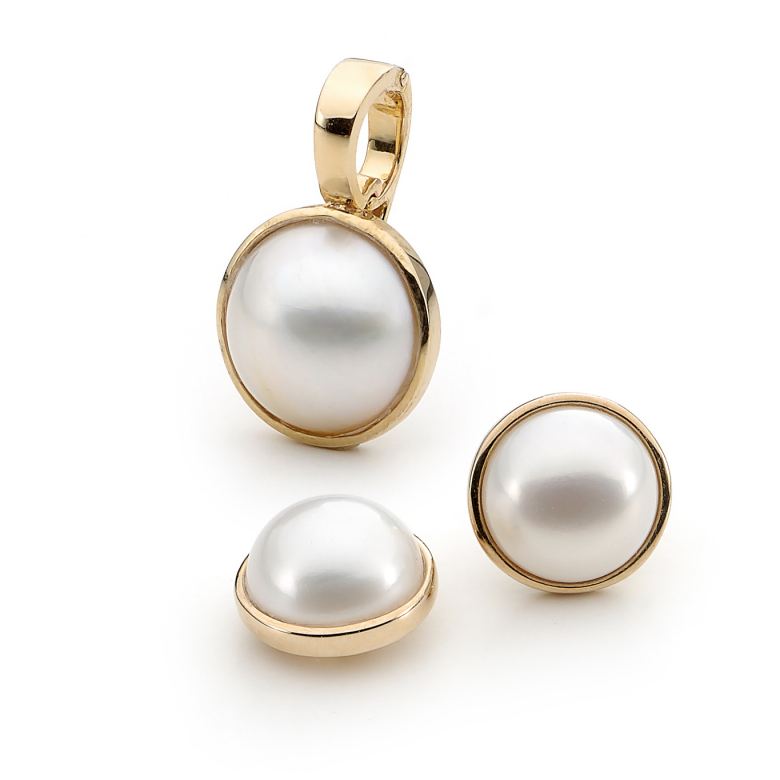
Mabe pearls, also known as blister pearls, are formed in a unique and fascinating way. This type of pearl originates when one or more hemispherical nuclei, made of shell or plastic, are attached to the inner shell of the oyster, just beneath the mantle. In response to this "intruder," the oyster naturally begins secreting layers of nacre, encasing the nucleus in a defense process that, over time, creates the Mabe pearl.
These pearls are produced by species like the Pinctada Margaritifera and Pteria Penguin, cultured in tropical waters of places like Japan, Indonesia, and Australia. The cultiring period varies between 6 and 24 months, depending on the oyster species and environmental conditions. Once this period is complete, the oyster is harvested, and the half pearls are found firmly attached to the shell. To release these pearls, a delicate cutting process with specialized tools is performed, during which the original nucleus is removed, leaving only a hollow half-sphere of nacre. This hollow is then filled with epoxy resin, and a small piece of nacre shell is attached to the back to complete the pearl.
Mabe pearls are highly valued for their hemispherical shape and characteristic luster. They are relatively easier to obtain than fully spherical or round pearls, which is reflected in their generally more accessible price. However, high-quality Mabe pearls with beautifully formed nacre can command higher prices, especially when they are larger. Their uniqueness and charm make Mabe pearls an attractive and versatile choice for fine jewelry.
Imitation Pearls, Mallorca Pearls
They are neither natural nor do they look like it
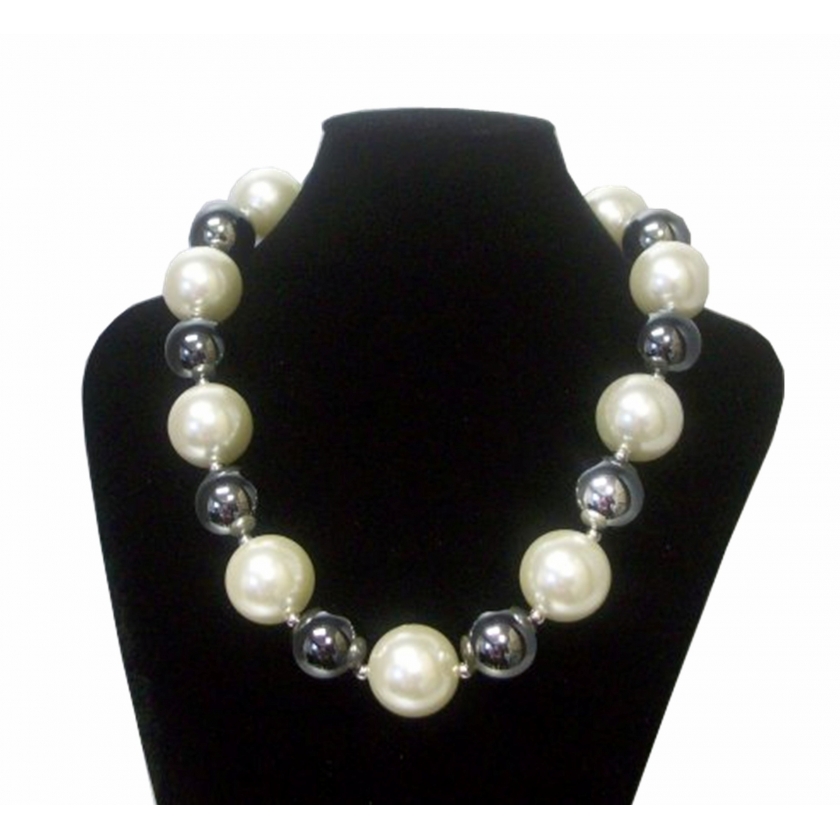
Imitation pearls are artificial products manufactured through mass production processes, resulting in thousands of identical items. Typically, they are created by dipping a glass or plastic bead into a solution made from fish derivatives. This solution forms a thin layer around the spherical core, which may initially mimic the appearance of a natural pearl but inevitably tends to degrade with use and over time.
A simple way to identify an imitation pearl is by gently biting it. Fake pearls feel smooth when they glide over your teeth, while authentic pearls have a slightly gritty texture due to their nacre surface.
Imitation pearls are sold under various names, and unfortunately, some of these terms are used to mislead consumers. Names like "Shell Pearls," "Fashion Pearls," "Style Pearls," "Faux Pearls," "Simulated Pearls," "Organic Pearls," "Mallorca Pearls," "Menorca Pearls," and other regional terms refer to artificially manufactured pearls, not natural ones. It's important to be well-informed to avoid being misled when purchasing pearl jewelry.